

TL;DR — A UGC creator makes content brands use as their own — usually as ads — rather than posting it to their own audience for reach. It is paid per deliverable, not per follower, which is why follower count is close to irrelevant to getting hired. What gets you hired is a portfolio of finished work in a category a brand is already buying.
Reviewed 21 August 2026 by the Linkie team.
A UGC creator is a paid content producer hired for the assets they make, not the audience they have. That's the clean answer, and it's why the role sits closer to a freelance creative supplier than an influencer, even though the two often get lumped together.
The confusion usually starts when a brand wants a TikTok ad that feels native, not polished, and someone on the team says, “Find a creator.” What they usually need is a person who can make reusable videos, photos, testimonials, and product demos that the brand can publish on its own channels, not a personality built around follower reach.
What a UGC Creator Does
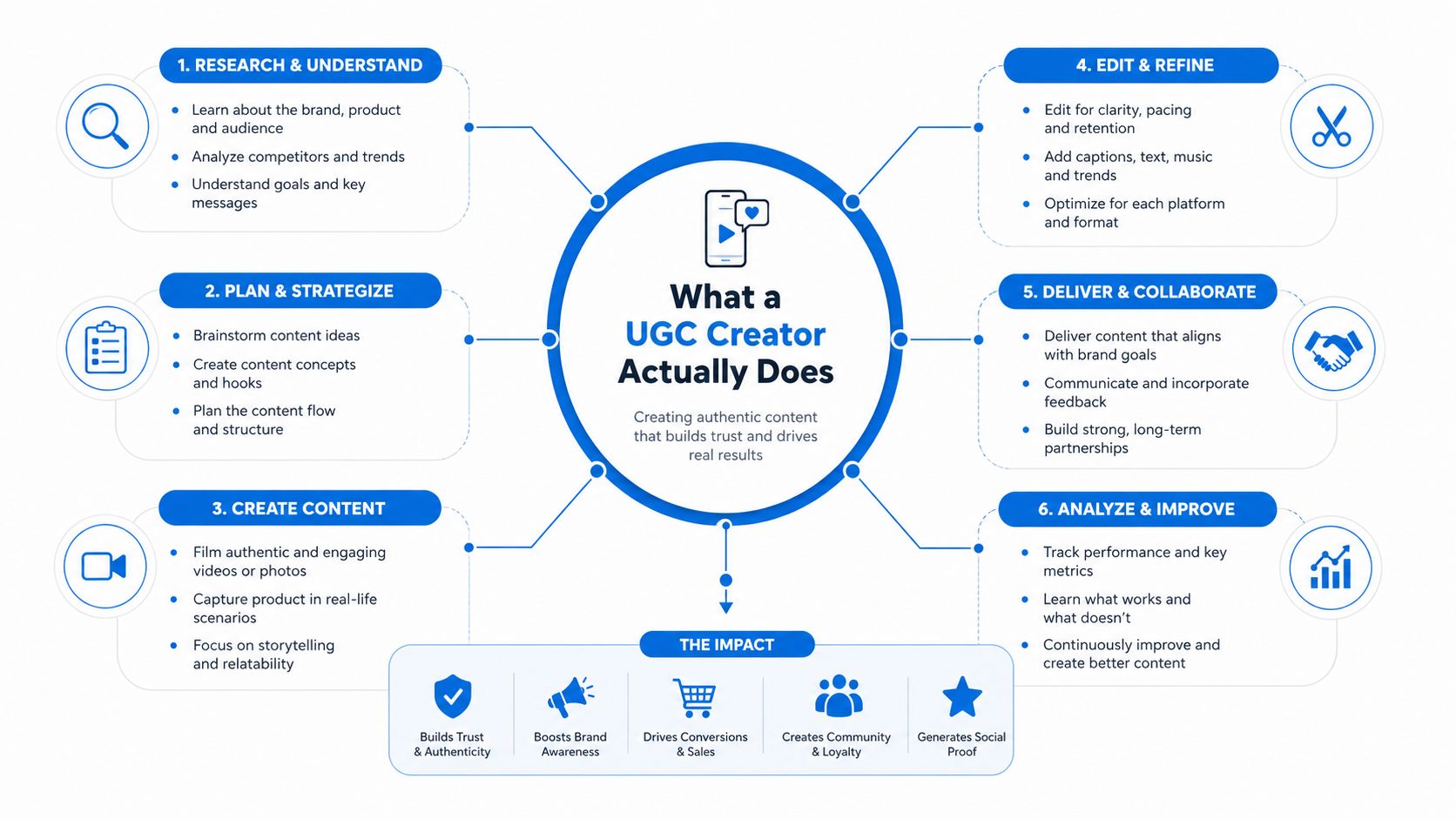
A UGC creator makes brand-usable content assets and hands those files to the brand for publishing. In practice, that usually means short-form video, photos, reviews, testimonials, tutorials, or a mix of those formats, delivered in a way that fits TikTok, Instagram Reels, YouTube Shorts, paid social, landing pages, or product pages [Buffer] [UNIR].
Asset-first, not audience-first
The core shift is simple. A creator is paid for production, because the brand wants the content itself and the usage rights attached to it. An influencer is paid partly for reach, because the creator's audience is part of the package [Iconosquare].
Follower count matters less in this model. The buyer is usually a marketing team, not a fanbase, and they care more about whether the first second hooks, whether the proof feels real, and whether the file can be reused across ads and pages. A creator can have a small social presence and still be worth hiring if the content solves that problem.
A practical rule helps here. If a brand is paying for the post, the audience is secondary. If a brand is paying for the creator's distribution, the role is closer to influencer marketing.
The work also rewards creators who understand performance, not just aesthetics. A polished clip that looks nice in a portfolio can still lose to a rougher cut that stops the scroll and makes the offer clear. That is why brands often look for people who can build repeatable hooks, direct proof, and straightforward demonstrations, then test those assets across placements.
For creators who want to earn from distribution as well as production, a clear breakdown of how creators monetize Instagram traffic can help set expectations about what brands are really buying. The same logic applies here, because the value sits in the asset and its use, not only in the account behind it.
What the brand actually receives
In practice, the deliverable might be a vertical video filmed on an iPhone in a kitchen, cut to feel like a casual recommendation, then launched by a skincare brand as a TikTok Spark Ad. That same video can also be used on a website, in email, or inside a product page if the rights allow it [Later].
The brand is buying files it can run, test, and reuse. That usually includes a set of creative assets, sometimes with alternate hooks, different captions, or extra stills for paid and organic placements. A useful brief spells out the product claim, the tone, the must-show details, the usage window, and where the content will live, because those choices shape both the shoot and the price.
That is the job. The creator is building conversion-friendly assets that feel peer-made without being random, and that gives brands material they can use across paid media, landing pages, and email.
Why Follower Count Is the Wrong Metric
Follower count is the wrong lens because the brand is not paying for reach in the usual sense. In this model, the creator is a production partner, and the brand is buying files, usage scope, and the right to test creative across placements.
A creator with a small audience can still outperform a bigger name if the content looks natural, gets to the point fast, and fits the platform. That gap shows up most clearly when a brand needs multiple variations of one idea, because one creator can shoot several hooks, several opens, and several proof angles without needing a large following. The value sits in the asset, not the account, and a clear breakdown of how creators monetize Instagram traffic helps set expectations about what brands are buying.
Why brands care more about the asset than the account
Brands use UGC to mimic peer recommendation while keeping control over distribution. That changes the hiring logic. The portfolio matters more than the media kit, because the buyer is judging whether the creator can make content that looks believable inside a feed, not whether the creator can drive traffic to their own profile [Hootsuite].
That also changes pricing. The value is less about audience size and more about how well the creator can deliver content that feels trustworthy and can be reused in paid media, landing pages, and email. The brief often centers on hook rate, authenticity cues, format fit, the product claim, the tone, the must-show details, the usage window, and where the content will live, because those choices shape both the shoot and the price.
Brands that still ask first for follower count are usually hiring the wrong role.
What a new creator should build instead
A new UGC creator needs proof, not vanity metrics. A strong starter portfolio usually means 10 to 20 assets that show range, even if none of them have gone viral. The goal is to prove that the creator can handle different openings, different product categories, and different tones without losing clarity.
A practical portfolio stack looks like this:
Three fast hooks, because the opening line is what stops the scroll.
A few product demos, because showing the product in use beats describing it.
A testimonial or two, because social proof is the point.
One or two static visuals, because not every brand wants video first.
A small audience does not block good work. Some brands want a creator who can make repeatable assets for ads and product pages, while others care more about personal influence and community reach. If the work is strong, the follower count stops being the first question. Brands hire the asset, then keep hiring the creator who can reliably make more of the same kind of asset.
UGC Formats and the Platforms They Live On
UGC isn't one format. It's a basket of deliverables that each fit a different job in the funnel. The creator who only knows how to film one type of video usually runs into trouble the moment a brand wants assets for TikTok ads, Reels, product pages, and email at the same time [UNIR].
Format by format
Unboxing videos work best on TikTok and Instagram Reels because the first few seconds can feel like a real discovery moment. Brands usually want vertical video, short runtime, on-screen text, and a caption that mirrors the spoken hook.
Talking-head testimonials are common in TikTok ads. The technical expectation is usually vertical, face-centered framing, clear audio, and captions burned in or supplied separately, because many viewers watch muted.
Voice-over product demos fit YouTube Shorts well when the brand needs a bit more explanation without losing pace. These usually need a vertical cut, quick scene changes, and concise text overlays that don't crowd the frame.
Static carousel photos do real work on Instagram and Facebook, especially for brands that want to show multiple product angles or before-and-after states. The files need clean composition, readable text when overlaid, and enough flexibility for ad placement.
Before-and-after reviews are common in skincare and fitness because the format naturally supports proof. The creator has to be careful here, because the value is in credibility, not dramatic editing.
Podcast-style audio clips can support email and landing pages when a brand wants a voice-led testimonial. The file still needs to be clear, clean, and easy to pair with visuals.
Written reviews show up on product pages and Amazon listings. They're plain, but they still matter because they help shape trust at the point of purchase.
UGC Format to Platform Match | Best Platform | Typical Spec | Common Use |
|---|---|---|---|
Unboxing video | TikTok, Instagram Reels | Vertical, short, text overlays, caption copy | Discovery and social proof |
Talking-head testimonial | TikTok ads | Vertical, clear audio, burned-in captions | Direct-response ads |
Voice-over demo | YouTube Shorts | Vertical, fast cuts, concise text | Product explanation |
Static carousel photos | Instagram, Facebook | Multi-image set, clean composition | Paid social and feed content |
Before-and-after review | Skincare, fitness pages | Clear framing, simple edits, strong proof cues | Trust building |
Podcast-style audio clip | Email, landing pages | Clean audio file, short excerpt | Testimonial support |
Written review | Product pages, Amazon listings | Plain text, concise and specific | Purchase reassurance |
Briefing shortcut: match the format to the job. If the goal is scroll-stopping, use video. If the goal is comparison or proof at the point of purchase, use static or written assets.
What a creator should ask before shooting
Aspect ratio: vertical for short-form, square or carousel-friendly for feed assets.
Length: enough to land the hook, but not so long that it drifts.
On-screen text: whether the brand wants subtitles, callouts, or no text at all.
Caption delivery: whether the caption is part of the file handoff or a separate copy doc.
The fastest way to miss the brief is to create the right content in the wrong format. Brands don't just buy “UGC.” They buy a specific asset for a specific channel.
How a UGC Project Runs
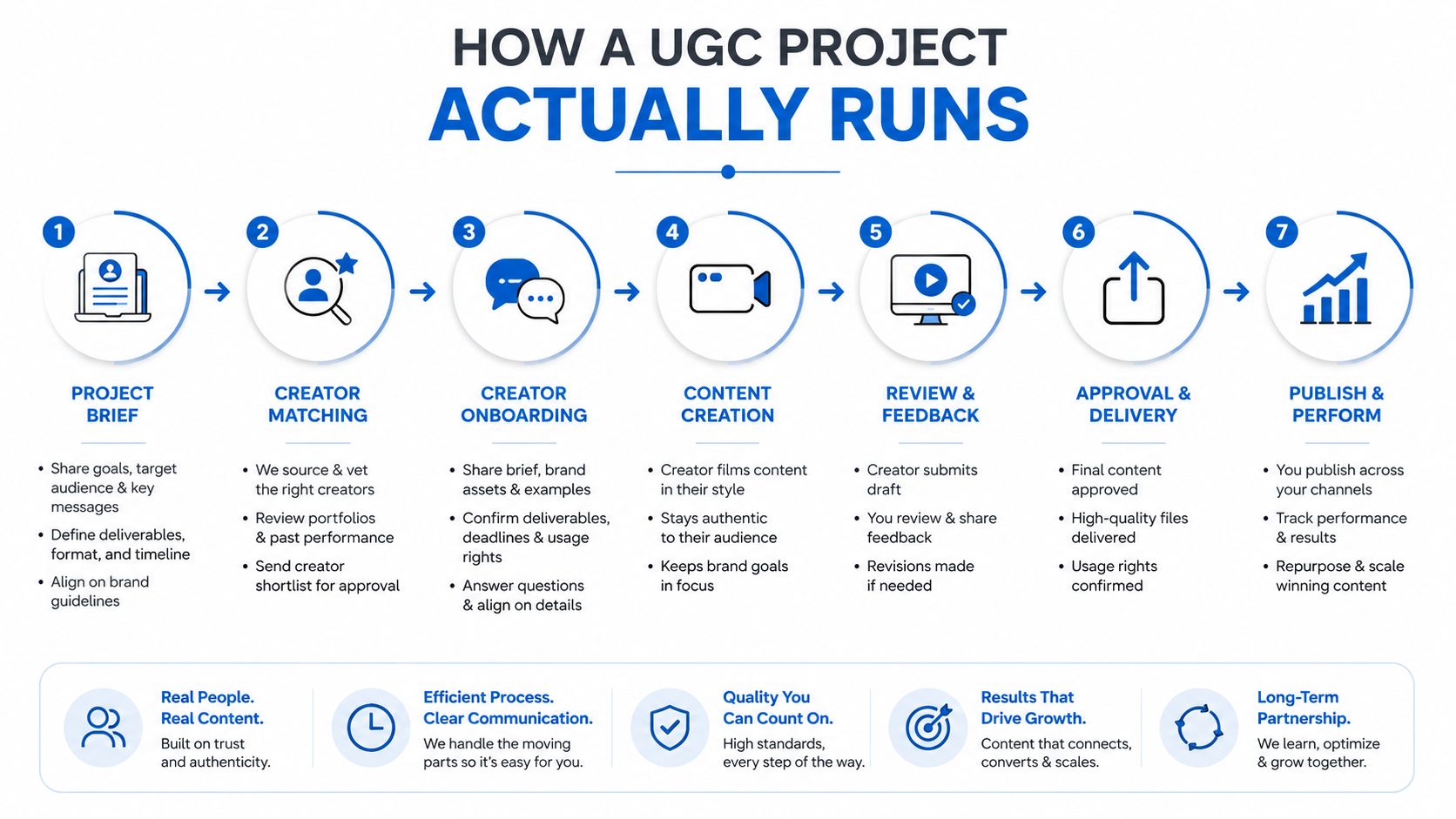
A paid UGC project often starts in a Google Doc, Notion board, or Trello card. The brand lays out the product, the angle, the deliverables, the deadline, and the placement, then the creator turns that brief into assets the brand can use in its media stack.
The usual path from brief to publish
A DTC skincare brand hiring a creator for a 30-second moisturizer ad usually follows the same sequence. The brief comes first, then the contract, then the shoot, then raw file delivery, then any revisions that were agreed in advance, then publishing on the brand's channels or ad account [UGC Slalom].
That contract matters more than many newcomers expect. The biggest miss is failing to spell out whether the brand can run the asset in paid media, or whether it is limited to organic posting only. If the rights only cover organic use, the creator should not assume the brand can drop the video into Meta Ads or TikTok Ads.
Revision scope causes another common problem. If that part is not defined, a brand may ask for extra edits after the first cut, and the creator can lose time fast. A clear agreement on revision rounds keeps the project from becoming a chain of tiny changes.
The rights conversation that protects both sides
Usage rights are not a side note. They define where the brand can use the asset, how long it can use it, and whether it can be whitelisted or run as a Spark Ad. Organic-only rights are lighter. Paid usage rights are more valuable because they let the brand put the content behind media spend and scale it.
That distinction matters in creator ads. A piece of content that works in a feed post may perform very differently once the brand pays to put it in front of a broader audience. The creator needs to know where the file will live, and the brand needs to know what it is allowed to do with it.
A clean onboarding checklist looks like this:
Brief received: product, angle, deliverables, deadline.
Rights defined: organic only, paid usage, or both.
Revision count agreed: one round, two rounds, or fixed edits only.
File format confirmed: raw, edited, captions, and captions file.
Publishing scope clarified: feed, ads, website, or all approved channels.
Pricing, Usage Rights, and What to Charge
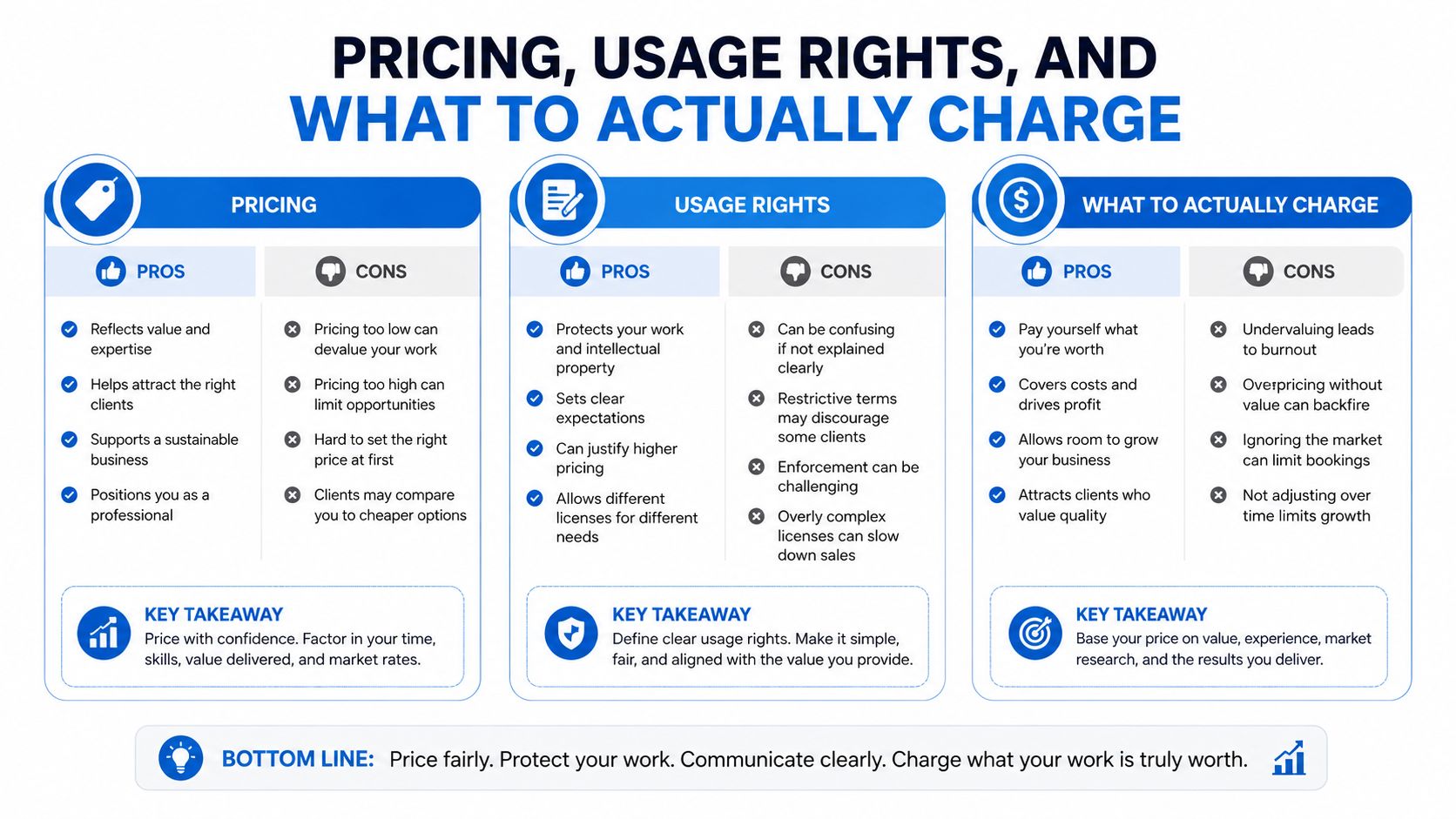
UGC pricing usually breaks into two parts, the base fee for creating the asset and the add-ons for how the brand can use it. The add-ons are where a lot of beginners undercharge, especially when paid usage rights, whitelisting, expedited delivery, or extra revisions get folded into one flat number. A brand is rarely paying only for a video file. It is paying for the right to use that file in a specific way, and that changes the price.
What drives the fee
A short-form video costs more when the brand wants broader usage because the creator is giving up more value. A 60-second TikTok licensed only for organic posting is a different deal from the same clip licensed for paid usage for 90 days, because the second version can be distributed more aggressively and tied directly to ad spend. That difference should show up in the quote.
The contract should always spell out:
Deliverables, so everyone knows how many assets are included.
Deadlines, so the handoff date is clear.
Usage scope and duration, so organic, paid, and time windows are defined.
Exclusivity, so the creator knows whether similar products are off-limits.
Kill fees, so the creator is protected if the project gets canceled late.
Practical rule: if a brand wants broader distribution, the creator should expect a higher fee. More usage means more value transferred.
A creator also needs to know the shape of the job before setting a number. One raw clip, one edited ad cut, and a bundle of hooks, captions, and alternate endings are not priced the same way, even if they start from the same shoot. Revisions change the workload too. A simple note on a thumbnail is one thing, a round of rewrites after the final cut is another.
How to think about the money side
A base rate per asset is the starting point. From there, usage rights, whitelisting, and rush delivery should all be treated as separate line items or clearly scoped add-ons. Brands that want creator content in paid media should expect to pay a meaningful premium, because that content is no longer just a deliverable, it's an ad asset.
Creators should be wary of any clause that grants perpetual global rights for a flat fee without a usage premium. That deal transfers too much control too cheaply. Brands should push for clear terms up front so the same asset does not turn into a licensing dispute later. If the brand wants to test multiple placements, the pricing should reflect that distribution plan instead of hiding it inside a single flat fee.
The practical question is not what a UGC post looks like in a portfolio. It is how much value the brand can extract from it once it is live. Organic-only usage, paid social, landing pages, and whitelisting all sit at different levels of control and exposure. The more control the brand wants, the more the creator should charge.
What good contract language protects
Good UGC contracts remove ambiguity. They do not just say “content creation.” They say what gets made, where it can be used, how long it can run, and what happens if the brand wants more placement flexibility later. That is how both sides avoid the awkward follow-up email two weeks after launch.
The cleanest pricing conversations feel boring, and that is a good sign. If the usage rights are clear, the creator can focus on the creative, and the brand can focus on performance. For creators, that also makes it easier to package a UGC portfolio in a way brands can scan quickly, because the deliverables, usage terms, and outcomes are easier to compare from one project to the next.
UGC vs Influencer Marketing vs Traditional Creative
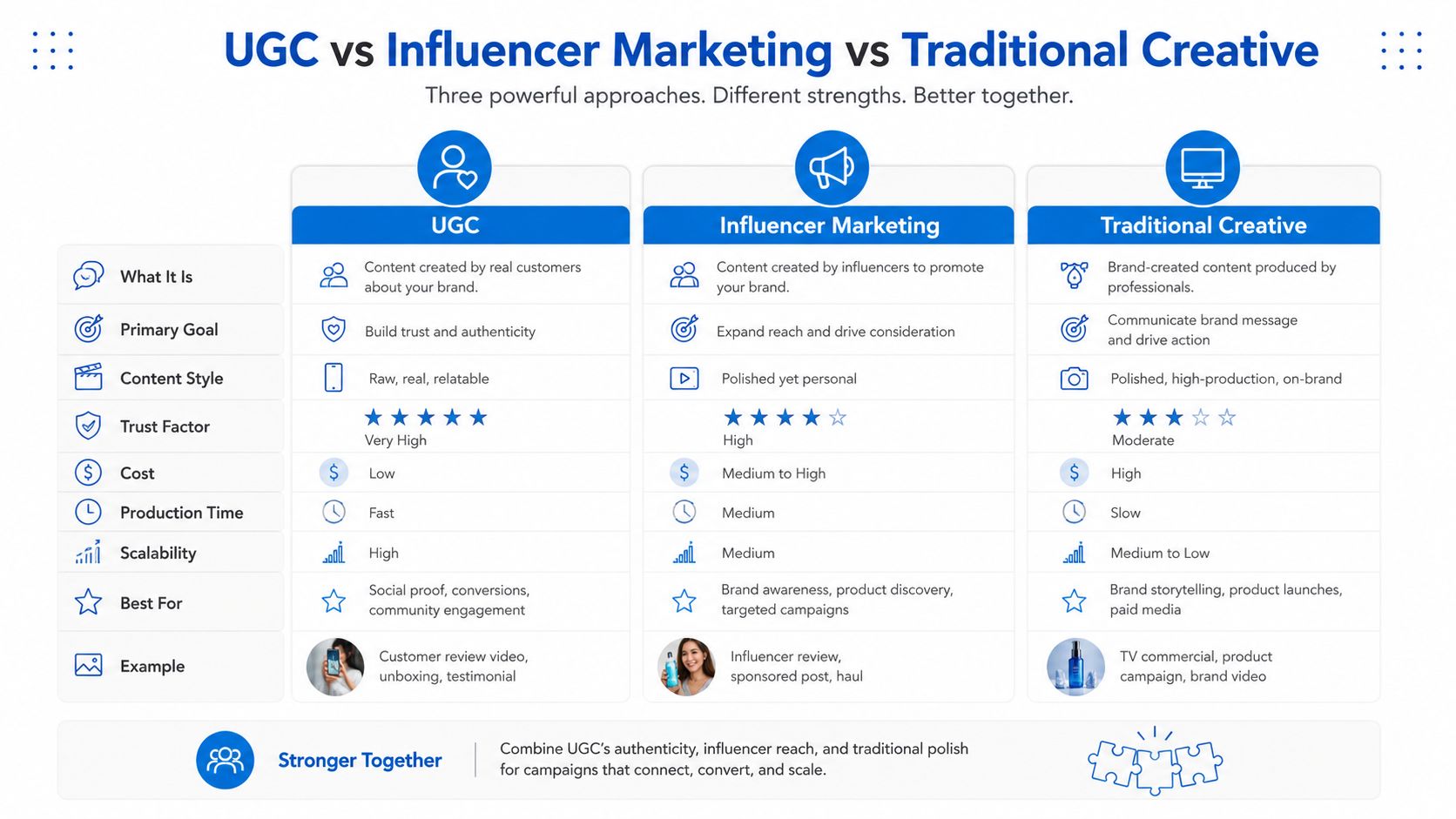
A brand hiring for paid social, an awareness push, or a flagship launch is not buying the same thing each time. UGC, influencer marketing, and traditional creative can all produce short-form video, but each one serves a different job, and mixing them up leads to the wrong brief, the wrong budget, and the wrong expectation for results.

Which model fits which goal
UGC is the most efficient option for producing high-volume, native-looking assets that can be tested in paid media and on product pages. It fits campaigns where the goal is stronger hook rates, lower acquisition costs, or a steady stream of creative variants that can be swapped fast.
Influencer marketing makes more sense when the brand is paying for reach, awareness, or trust inside a defined audience. The creator's own distribution is part of the value, so the post is doing two jobs at once, content and media buy.
Traditional creative agency work is the stronger choice when a brand needs a polished hero campaign, controlled brand storytelling, or a flagship asset that carries the launch rather than supports a test.
Model | What it delivers | Best use case | Weak spot |
|---|---|---|---|
UGC | Brand-usable content assets | Paid social, landing pages, product pages | Less suited to prestige storytelling |
Influencer marketing | Content plus audience access | Reach, awareness, niche trust | More expensive for distribution |
Traditional creative | Polished campaign assets | Brand equity, flagship launches | Slower and usually costlier |
The practical decision usually comes down to the KPI. If the brand needs direct-response efficiency in paid social, UGC is often the cleanest fit. If the team wants follower growth or broad reach on a brand account, influencer marketing is the better match. If the objective is brand platform work, traditional creative earns its place.
A useful way to separate them is to ask what the asset has to do after it is delivered. UGC should be easy to test, iterate, and place across channels. Influencer content should bring audience access and social proof with it. Agency creative should carry more polish and a clearer brand point of view.
That difference also shapes the brief. A UGC brief should spell out the hook, the pain point, the product claims that can be made, the format, and the usage rights. An influencer brief has to account for the creator's audience, posting context, and how much control the brand is willing to give up. A traditional creative brief usually spends more time on concept, brand alignment, and campaign cohesion.
The link between format and intent is easier to see in a side-by-side breakdown of UGC, influencer marketing, and traditional creative. Once the goal is clear, the trade-off becomes obvious. UGC gives speed and testing room. Influencer marketing gives distribution. Traditional creative gives polish and control.
The reason UGC has grown so quickly is straightforward. Brands can buy content that feels native to social proof, then use it across paid placements, landing pages, and product pages without relying on a single creator's audience. That mix of flexibility and lower production cost is hard to beat when media spend needs to work harder.
UGC Creator Bio Examples for Instagram and TikTok
A UGC creator’s bio does a different job from an influencer’s. You are not selling reach to a follower — you are selling a service to a brand, and the person reading is usually a marketer checking whether you are worth a message. That changes what belongs in the 150 characters.
Name the role, not the aspiration: UGC creator reads as a job title, content lover does not. Name the categories you actually shoot — beauty, food, home, fitness — because briefs are assigned by category. Say whether you are open to work, in those words. And point the link at a portfolio, not a link tree of social profiles; the brand already found your socials. A worked pattern:
UGC creator · beauty & skincare · raw + edited deliverables · open for briefs → portfolio below
That structure works on both platforms. On TikTok the character limit is tighter, so drop the deliverables line first. More bio patterns in Instagram bio examples for creators.
How to Start and Get Hired as a UGC Creator
The fastest path in is not waiting for a brand to discover a social profile. It's building a compact portfolio, then making it easy for brands to see the work, book the work, and follow up without friction.
A practical starter plan
A creator should build 10 to 20 assets in a consistent style, then pitch a tight list of brands every week. Three sample videos are enough to show range if the hooks, framing, and pacing are strong. After that, listing on UGC marketplaces like Collabstr and Billo can help put the portfolio in front of buyers who already understand the format.
A creator link-in-bio page should include:
A portfolio reel, so brands get the fastest possible first impression.
Three to five best assets, because too many options slow the decision.
A booking form, so inbound interest can turn into a real lead.
A short about-me, so the buyer knows the niche and tone.
An email subscribe option, so warm leads can be nurtured later.
That's also where a simple landing page tool matters. A modern link-in-bio page can pull the portfolio, booking form, and email capture into one place, and a platform like Linkie can do that with a drag-and-drop page, lead collection, and email sync into Google Sheets. For creators who want a cleaner brand-facing hub, that setup keeps the business side from becoming a mess.
How to build a personal brand online
The pitch itself should stay short. A useful cold email usually points to a few sample assets, names the brand category, and makes the next step obvious. If the work is good and the page is clean, brands don't need a long explanation.
Measuring UGC Performance and Best Practices for Both Sides
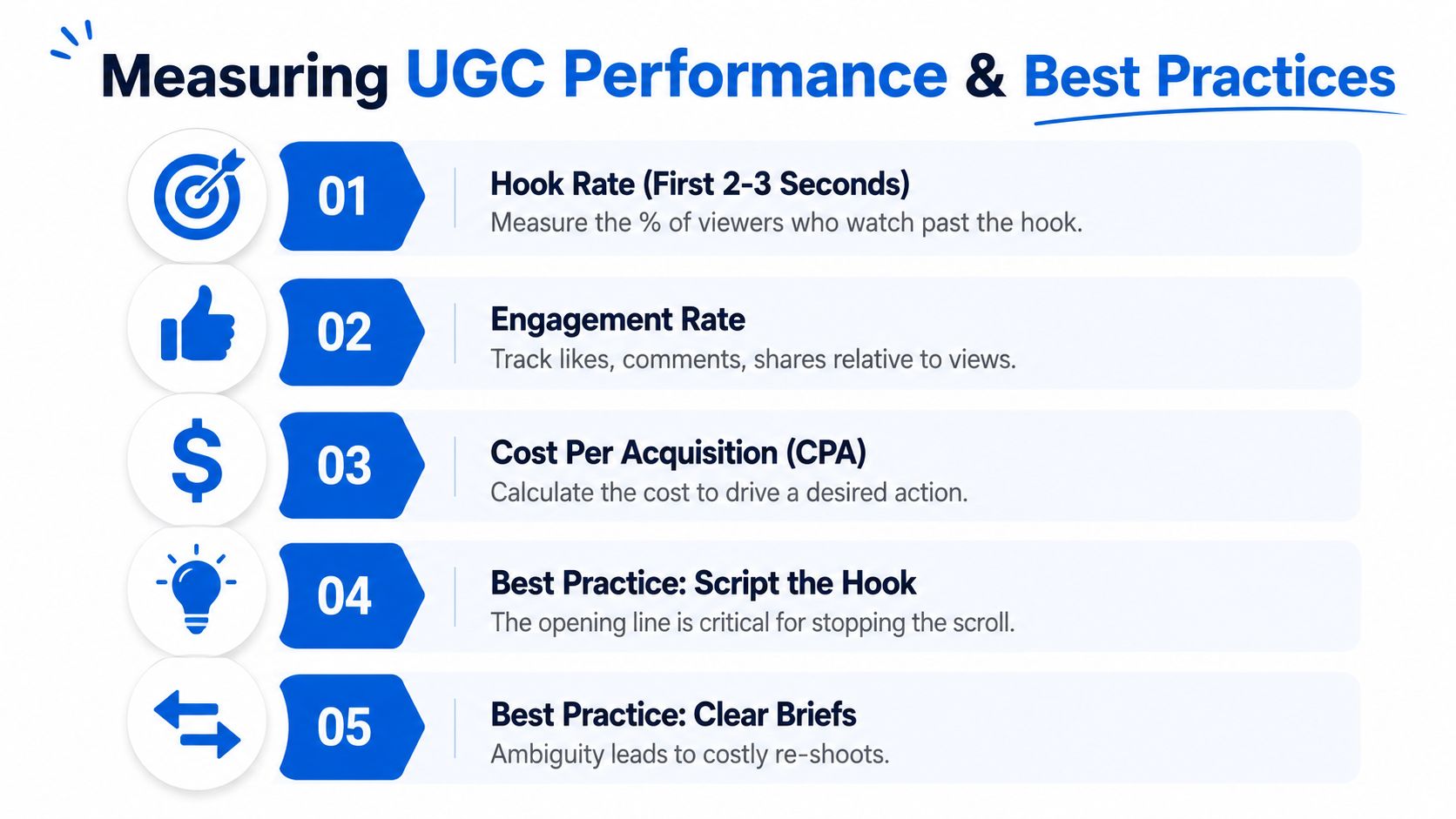
The metrics that matter most are the ones tied to actual movement, not vanity. For paid assets, that usually means hook rate in the first two to three seconds, hold rate, click-through rate, cost per acquisition, and ad-attributed conversion lift [Later].
What creators should optimize for
The strongest creators lead with the hook, deliver raw files alongside edited ones, negotiate usage rights properly, build a real portfolio page, and treat each brand like a repeat client rather than a one-off sale. A link-in-bio page with real-time analytics can also show which portfolio pieces are turning brand interest into calls, which is useful when the creator is deciding what to feature.
What brands should do better
Brands get better results when they brief on outcome, not style. They should pay a usage premium, test multiple creators against the same brief, whitelist top performers, and refresh creative every few weeks so ad fatigue doesn't kill the campaign.
Strong UGC teams don't chase “pretty.” They chase assets that earn another test.
FAQ
Do UGC creators need to disclose paid partnerships on their own feed? Not usually, because they're not publishing the asset on their own feed in the first place. The brand is the one distributing the content.
How long does a typical UGC project take? It depends on the brief, revisions, and rights discussion, but the workflow is usually quick once the scope is locked.
Does a UGC creator need to register a business? Many do once the work becomes regular, because brands prefer clean invoicing and clearer ownership terms.
If the goal is to turn UGC into a repeatable part of the business, Linkie gives creators a simple place to show portfolio assets, collect leads, and track which pieces get clicks. A clean page makes it easier for brands to say yes, so creators who want one landing spot for their work can visit Linkie and build it from there.