


TL;DR — TikTok traffic is won in the video, not the bio. The video has to create a reason to leave the app, and the bio link has to deliver exactly what the video promised — mismatch between the two is where nearly all TikTok traffic leaks.
Reviewed 21 August 2026 by the Linkie team.
A lot of TikTok accounts are stuck in the same loop. Videos get views, comments look healthy, and the profile still sends almost nobody to the site, store, booking page, or lead form.
That usually happens because the account is treating traffic like a caption problem. It isn't. How to drive traffic from TikTok is a funnel problem. The video has to create intent. The profile has to confirm relevance. The destination has to feel like the next obvious step, not extra work.
The accounts that pull this off consistently don't rely on one trick. They build a system.
How to Drive Traffic From TikTok: The Strategy
Views are easy to chase. Traffic is harder because TikTok users open the app to be entertained first, not to leave it.
That's why the old advice to just tell people “link in bio” falls flat. TikTok's business guidance pushes a more hybrid model where organic content and ads can drive people to different touchpoints, including external sites and TikTok Shop, depending on the goal, as explained in TikTok's commerce guidance for online and offline sales.
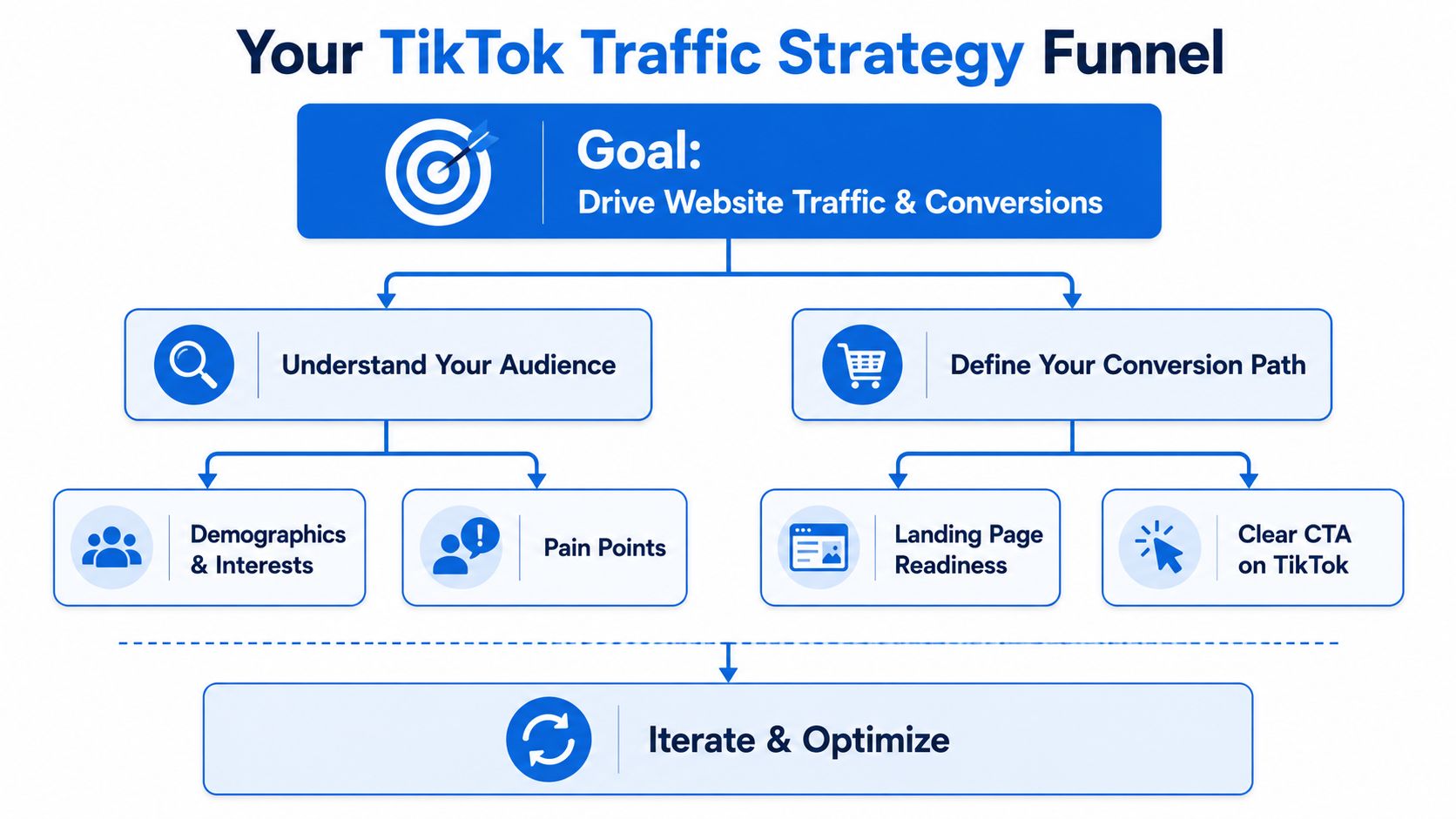
Pick one traffic goal first
Most weak TikTok funnels fail because a single video tries to do five jobs.
A traffic video should send people to one of these destinations:
A product page for direct purchase intent
A lead magnet page for email capture
A booking page for service businesses
A content hub or blog post for education and warm-up
An in-app shop destination when instant purchase behavior matters more than site visits
If the destination is unclear, the video gets vague. If the video gets vague, people watch, nod, and keep scrolling.
Practical rule: One video should have one business outcome.
Match the destination to the viewer's intent
Not every TikTok viewer is ready to click out. Some are curious. Some are comparison shopping. Some just want a fast answer.
That means the destination has to match the content angle:
Video angle | Best destination | What usually fails |
|---|---|---|
Quick demo | product page or product collection | generic homepage |
How-to tip | blog post, resource page, or email opt-in | pricing page |
Personal story | lead magnet or “start here” page | crowded link list |
Product proof | offer page or shop page | unrelated article |
Many creators and small brands waste effort here. They post awareness content, then send people to a page built for people who already know the offer.
Decide what success means before posting
Traffic goals need different success signals.
A product launch cares about qualified clicks and purchases. A coach cares about lead quality. A musician may care more about routing traffic to a release, an email list, or a ticket page. A startup might prioritize remarketing audiences over immediate conversion.
For e-commerce brands, this distinction matters even more because buying behavior on TikTok has shifted. TikTok Shop generated $15.82 billion in U.S. sales in 2025, according to Sprout Social's roundup, citing eMarketer. That matters because users are increasingly willing to convert inside TikTok or right after engaging with content, not only after a traditional website visit.
A useful starting checklist looks like this:
Choose the destination: site, shop, form, or booking page
Choose the conversion event: sale, subscriber, application, or visit
Choose the content format: demo, tutorial, proof, story, or trend-led angle
Choose the follow-up path: retargeting, email nurture, or direct checkout
Traffic starts improving when the account stops asking, “How do more people click?” and starts asking, “What exact action should this video earn?”
Engineering Your Videos for the Click
A traffic-driving TikTok video has structure. It doesn't beg for clicks. It builds enough tension, proof, or curiosity that clicking feels like the natural next move.
TikTok's guidance on short-form content is clear on this point. Strong traffic videos follow a three-part flow: hook, value, CTA, with the hook first, validators in the middle, and a clear action at the end, as outlined in TikTok's short video best practices.
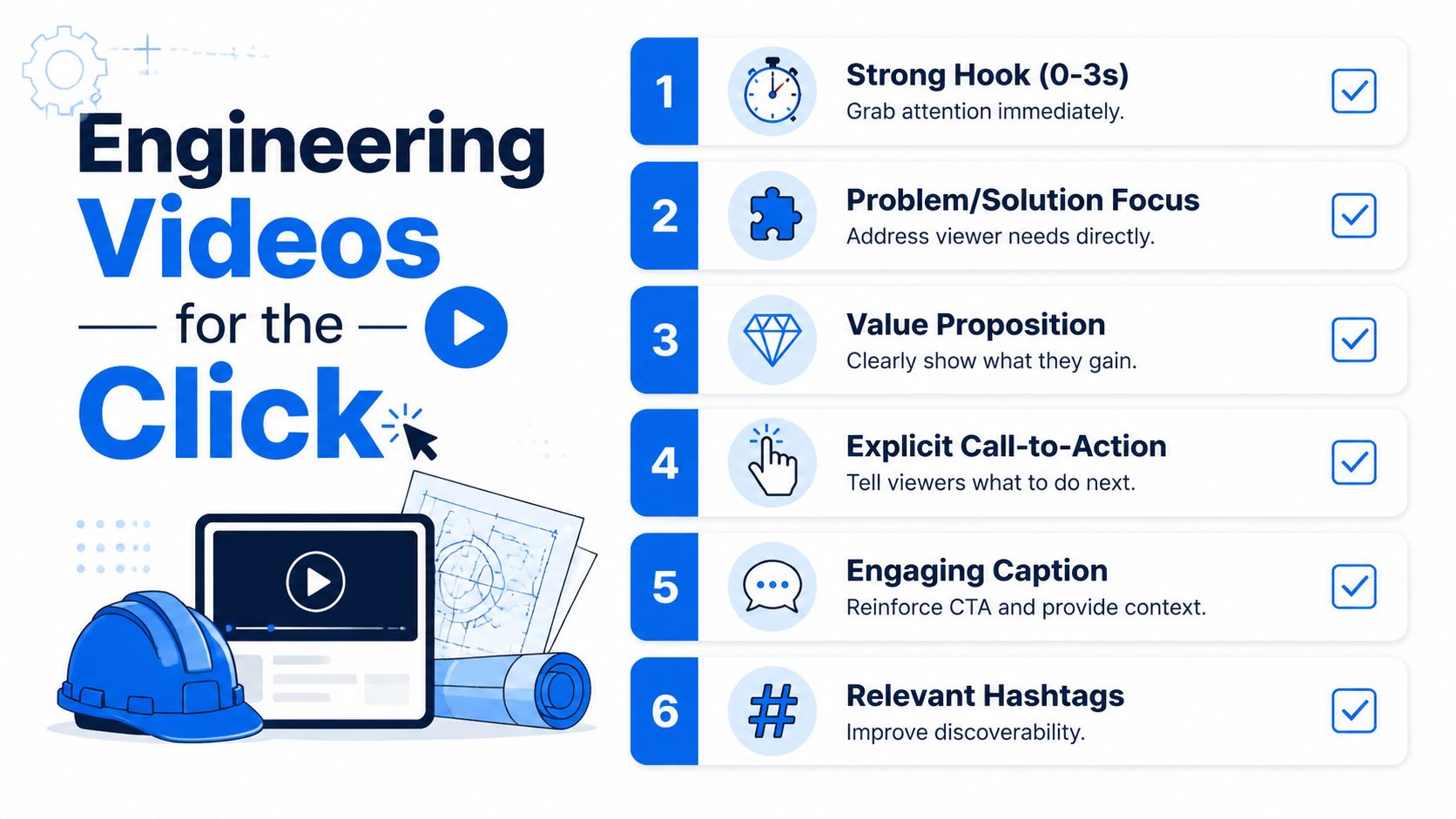
Build the first seconds for interruption
Most traffic videos die before the CTA because their openings are too soft.
The first seconds need to do one job. Stop the scroll by making the viewer think, “That's for me,” or, “I need the rest of this.”
Hooks that usually work better than generic intros:
Problem-first: “Most creators aren't losing views. They're losing clicks after the video ends.”
Outcome-first: “This is the TikTok format that gets people off the app and onto the offer page.”
Mistake-first: “If the only CTA is ‘link in bio,’ the funnel is probably broken.”
Proof-first: “This product sold best when the video showed the use case before the features.”
Hooks that usually waste time:
“Hey guys…”
“A lot of people asked…”
“So today we're going to talk about…”
“Three tips for success…”
Those are classroom openings. TikTok rewards motion and clarity.
Use the middle to earn intent
The body of the video should validate the promise made in the hook. At this stage, creators often overteach.
For traffic, the goal isn't to dump every detail into the video. The goal is to give enough value that the next click feels worthwhile.
A practical middle section often includes:
The problem in plain language
A fast demonstration or explanation
A proof point or validator
A reason the destination has more
The bio link isn't the strategy. The video is the strategy. The link just collects the intent the video created.
Examples by niche help make that concrete.
For e-commerce
Hook: “This is why people watch product videos and still don't buy.”
Middle: Show the product solving one specific problem, then show texture, fit, result, or before-and-after context.
CTA: “The full collection is in the bio.”
For coaches or consultants
Hook: “Most advice on content funnels skips the part that generates leads.”
Middle: Share one mistake and one fix, then mention the worksheet, webinar, or framework.
CTA: “The free training is on the page in the bio.”
For agencies
Hook: “If a brand asks for more views, that's not the same as asking for more pipeline.”
Middle: Contrast awareness metrics with business metrics, then reference the audit, checklist, or service page.
CTA: “The audit page is linked in the profile.”
Keep the CTA singular
Too many TikTok videos die at the finish line because they stack actions.
Bad ending: follow, comment, save, share, click, and DM.
Better ending: one direct instruction tied to the promised payoff.
Useful CTA lines:
“Get the full guide from the profile link.”
“The template is on the page in the bio.”
“See the full product options through the profile.”
“Watch this, then use the link in the profile for the checklist.”
A strong CTA is specific about what people get next. “Click the link” is weaker than “Get the launch checklist.”
Optimizing Your Profile and Bio Link Destination
A common TikTok traffic failure looks like this: a video gets solid watch time, profile visits climb, and website sessions barely move. The problem usually is not the link itself. It is the handoff between the video, the profile, and the page people reach after the tap.
That handoff gets harder on TikTok because the profile has to do more work than many teams expect. Accounts without access to a clickable bio link cannot depend on a direct path to the site, and even accounts that do have the link still need the profile to confirm relevance fast, as noted in Ignite Social Media's breakdown of TikTok traffic and conversions.
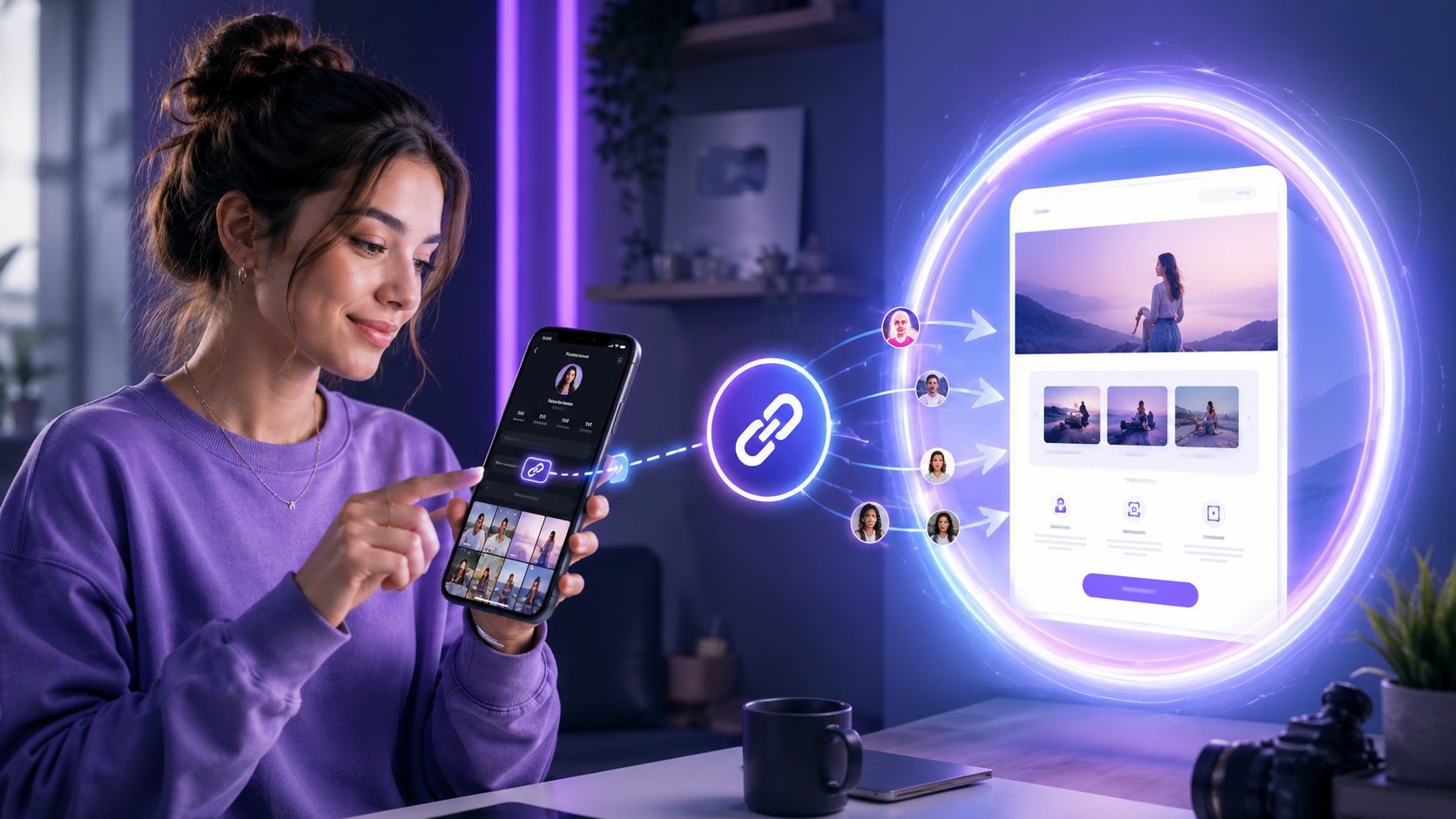
Treat the profile like a landing page
The profile has one job. Confirm that the viewer is in the right place and make the next action obvious.
Strong profiles answer these questions in seconds:
Who is this for
What problem does this account solve
What should someone do next
That is conversion work, not branding polish.
The accounts that get more traffic from the same number of views usually keep four elements aligned:
Username: easy to recognize and consistent with the brand name used elsewhere
Profile image: readable on a small screen, without extra design clutter
Bio copy: clear benefit first, not a clever line that hides the offer
Pinned videos: one proof asset, one offer asset, and one “start here” asset
Pinned videos carry more weight than many brands give them. I use them as the middle of the funnel. If someone does not tap the link on the first visit, the pinned set should answer objections, show proof, and restate the next step.
Why generic link pages lose clicks
A viewer who came from a specific TikTok usually has a specific intent. They want the product shown in the video, the template mentioned in the video, or the service tied to the problem in the video. Sending that person to a crowded page forces an extra decision, and extra decisions cost clicks.
The fix is a message match. The profile promise, the button copy, and the destination headline should feel like the same conversation.
Here is the difference:
Weak destination | Better destination |
|---|---|
ten unrelated links | one primary path and a few supporting options |
generic button labels | benefit-based labels |
no visual context | thumbnails, product cards, or embedded context |
mismatched branding | same offer, same tone, same visual cues |
Homepage links often underperform for this reason. They make sense for brand navigation. They usually perform worse for TikTok intent.
Build a destination that matches intent
For creators, agencies, musicians, coaches, and small businesses, a compact bio landing page often outperforms a standard homepage because it lets you control order, context, and measurement. That is where tools like Linkie can be useful. The practical value is not having “more links.” It is being able to group offers, feature the top action first, and see which cards get taps.
A solid destination usually includes:
One primary CTA above the fold
A short proof element, such as a featured video, offer card, or context block
A limited set of choices
Mobile-first layout
Fast load time and large tap targets
A quick walkthrough helps:
Accounts with low follower counts need a tighter system, not more dependence on the bio link. In practice, that means using the video to create intent, the profile to reinforce the offer, pinned posts to answer the next question, and the destination page to present one clear action.
Low traffic rarely improves because a team adds more buttons. It improves when every step after the video feels consistent and worth the extra tap.
Using Paid Ads to Amplify What Works
Paid TikTok traffic works best when it scales a proven idea. It usually works poorly when it tries to rescue a weak one.
TikTok's business guidance recommends an “always-engaged drumbeat” of organic content paired with paid campaigns, using organic posts to test resonance and paid campaigns to scale winners, as explained in TikTok's guide for small business marketing.

Start with the post that already proves intent
The smartest starting point is rarely a net-new ad creative. It's usually the organic post that already did one of these things well:
Held attention
Drove profile visits
Got comments that showed buying or research intent
Matched a landing page that converts cleanly
That's where Spark Ads make sense. They let brands amplify existing organic posts instead of guessing from scratch.
Boost for traffic, not vanity
There's a big difference between promoting a video because it looked popular and promoting a video because it moved people down the funnel.
A practical approach:
Find the organic winner with the strongest downstream behavior
Keep the original post style if it feels native and credible
Send traffic to a page that matches the exact promise in the video
Use paid spend to widen reach around the same offer, not a different one
Paid TikTok should act like an amplifier, not a life-support machine.
The common mistake is simple. A team boosts a video with broad appeal, then sends traffic to a weak page with no clear next step. The ad gets reach, but the funnel leaks immediately.
Keep the landing page friction low
When the campaign objective is traffic, the off-platform experience matters as much as the ad itself.
The destination page should:
load quickly on mobile
match the visual and verbal message from TikTok
present one obvious action
avoid clutter, pop-up overload, or too many choices
That setup gives paid campaigns room to scale. Without it, ad spend just magnifies a broken handoff.
Measuring What Matters for Traffic and Growth
If the goal is traffic, views, and likes are supporting signals. They are not the scoreboard.
TikTok performance should be measured across the full path, from video engagement to site behavior to conversion. That matters because a strong engagement rate of 4 to 6 percent is achievable for brands on TikTok, but the more important question is what happens after the click. The average conversion rate for TikTok traffic ranges from 0.5% to 5%, and landing pages that convert better tend to be mobile-optimized and fast-loading, according to Printful's guide to TikTok metrics.
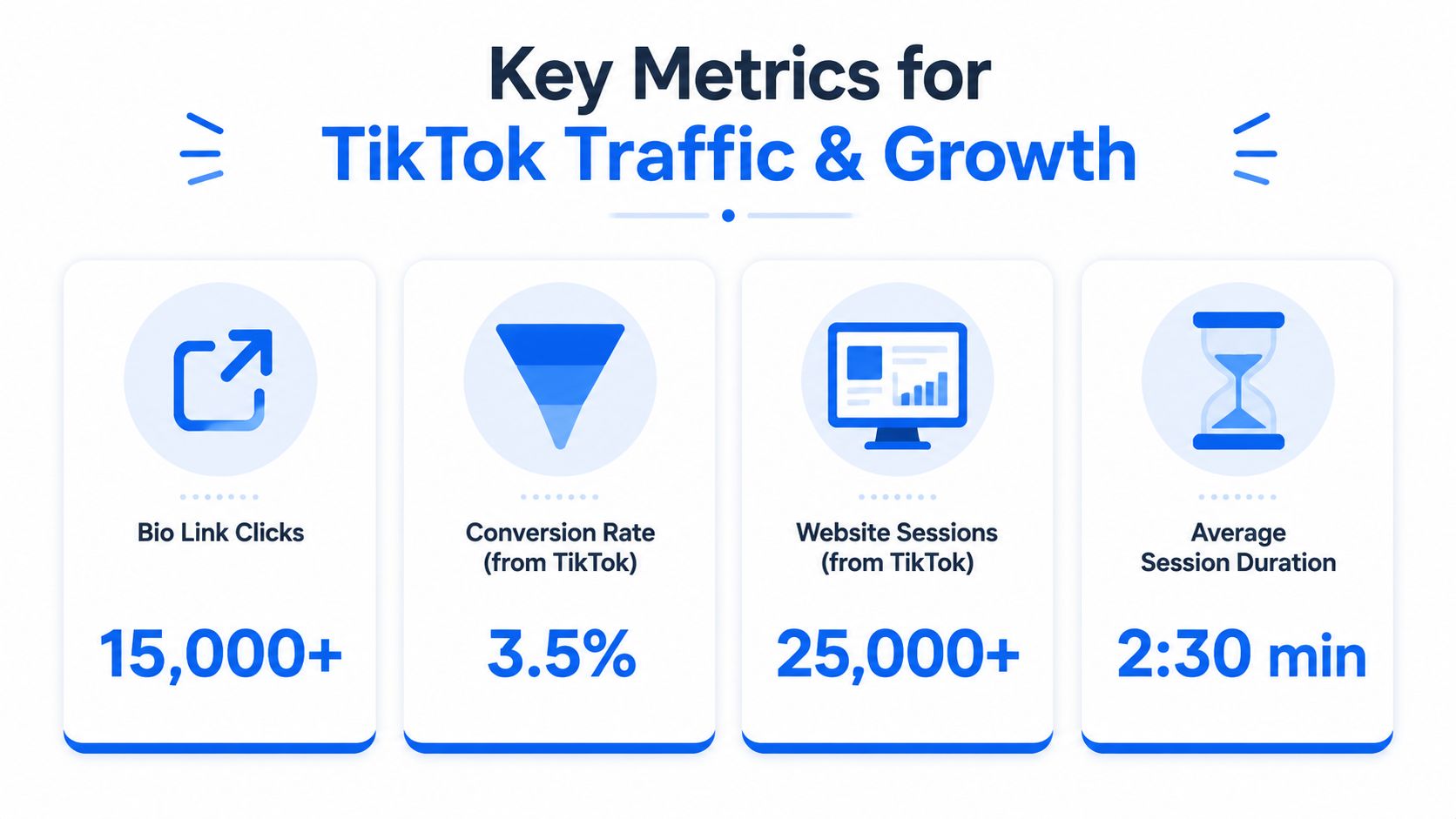
Watch the metrics that show movement
A simple traffic dashboard should connect on-platform and off-platform data.
On TikTok, useful metrics include:
Profile views
Website clicks
Watch time
Engagement quality
Post-level CTR when running ads
Off-platform, the important checks are different:
landing page bounce behavior
page-level conversion rate
email signups, purchases, or bookings
which cards or links get tapped most often
A post can look average in the feed and still be a strong traffic asset if it sends the right people to the right page.
Read the funnel in sequence
The cleanest way to diagnose weak traffic is to read the funnel in order.
Funnel point | If it's weak | Likely issue |
|---|---|---|
watch time | viewers drop early | weak hook or slow start |
profile visits | video gets engagement but few profile taps | CTA lacks urgency or relevance |
destination clicks | profile gets visits but clicks stay low | weak bio, pinned videos, or destination promise |
conversions | traffic arrives but doesn't act | landing page mismatch or friction |
This prevents the classic mistake of blaming the wrong layer.
Measurement rule: Don't ask whether the video “performed.” Ask where the user stopped.
Compare traffic quality, not just traffic volume
Many teams overvalue the post that gets the most clicks. That's incomplete.
The stronger post is often the one that sends better visitors. If one TikTok brings fewer sessions but more purchases, leads, or qualified form fills, that's the winner. The same goes for bio page analytics. Card-level click data is far more useful than guessing what people wanted.
For brands trying to learn how to drive traffic from TikTok, the most useful reporting habit is simple: review content, profile behavior, and landing-page outcomes together, not in separate silos.
Real-World Scenarios and Quick Wins
Theory matters less than execution. These three scenarios show how the full system works when the goal is clear.
E-commerce brand launching a collection
A skincare brand posts a short video showing one problem, then the product texture, then the result. The CTA is verbal and on-screen: “See the full collection from the profile.”
The profile pins one product explainer, one customer-proof clip, and one “start here” video. The destination page leads with the collection first, not the homepage. Quick win: remove every link that doesn't help the purchase decision.
Coach promoting a lead magnet
A business coach posts a fast educational video on one mistake prospects keep making. The closing line is: “The full worksheet is on the page in the bio.”
The profile bio states the audience and the result in plain language. The destination page displays the worksheet first, then the booking link below it. Quick win: lead with the free asset, since a cold TikTok viewer isn't usually ready for a call yet.
Agency generating qualified leads
An agency publishes short clips that contrast vanity metrics with revenue-focused reporting. The CTA says: “The audit page is linked in the profile.”
The destination page shows one audit offer, one proof asset, and one short contact path. Quick win: cut the agency site navigation out of the first landing experience. Most agency homepages ask visitors to wander. TikTok traffic needs direction.
These examples work because each one keeps the chain tight. The video promise matches the profile. The profile matches the destination. The destination asks for one next step.
Frequently Asked Questions
How many links should a TikTok bio destination have
Fewer than most accounts use. A single primary action and a few supporting options usually outperform a cluttered list. Too many choices weaken intent.
Can small accounts drive traffic without a clickable bio link
Yes, but not by waiting. Small accounts need stronger pinned videos, clearer profile messaging, and content that creates a reason to search, revisit, or engage through an intermediate step like email capture or retargeting.
Should TikTok traffic go to a homepage
Usually not. A homepage is often too broad for traffic from a single video. A focused landing page, product page, resource page, or compact bio hub is usually a cleaner fit.
What type of TikTok content drives the best traffic
Content that creates a clear gap between what the video gives and what the destination completes. Tutorials, demos, proof clips, and problem-solution videos tend to create stronger click intent than random trend participation.
Is TikTok Shop replacing website traffic strategies
Not entirely. It changes them. Some brands should prioritize in-app purchases. Others still need outbound clicks for lead generation, email growth, bookings, or building an owned audience. The right path depends on the offer and the funnel stage.
Why do videos get views but no clicks?
Usually, one of four reasons: the hook attracts the wrong viewer, the CTA is weak, the profile doesn't build enough trust, or the landing page creates friction. The fix is rarely just “post more.”
A clean TikTok funnel needs more than a single bio link. Linkie gives creators, brands, agencies, and small businesses a flexible way to build that destination with customizable cards, embeds, analytics, and email capture. To test a layout before publishing it, create a free page in the Linkie playground.
More on TikTok: best link in bio for TikTok · TikTok bio strategy.